
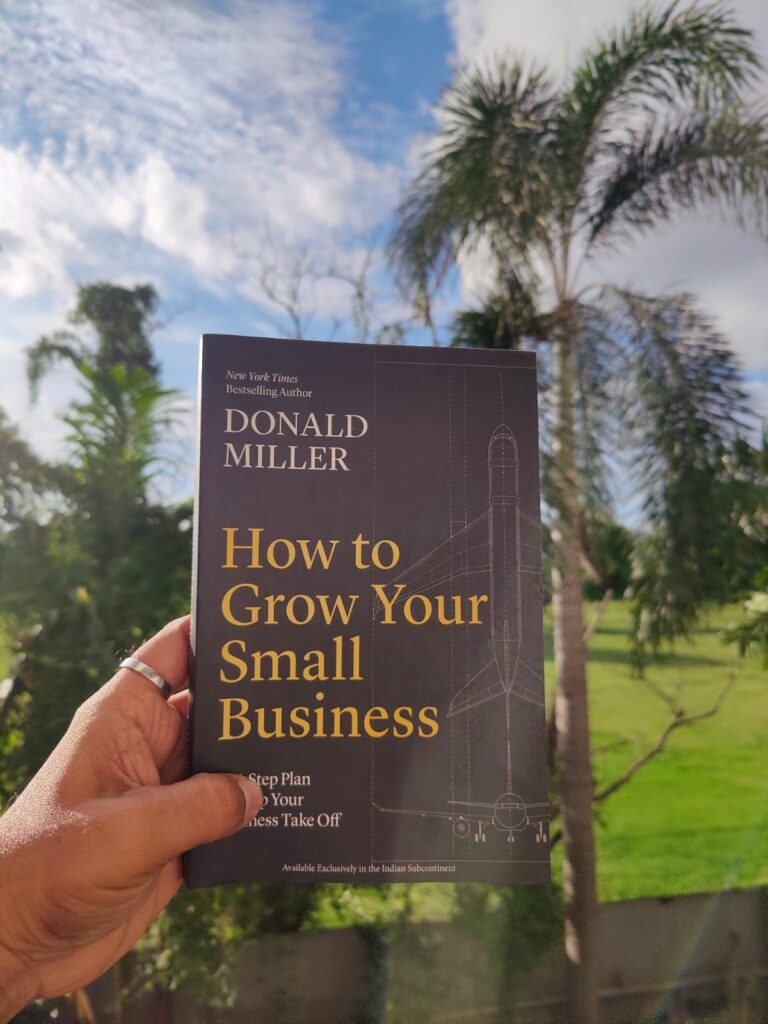
Donald Miller’s “How to Grow Your Small Business,” published in 2023 by HarperCollins Leadership, offers a structured roadmap for entrepreneurs struggling with growth. Drawing from Miller’s experience scaling his own company from a basement operation to a $15 million enterprise, the book uses an airplane metaphor to frame business as a “flight plan.” The six steps—Leadership (cockpit), Marketing (right engine), Sales (left engine), Products (wings), Overhead and Operations (body), and Cash Flow (fuel tanks)—aim to professionalize operations and deliver predictable results. Miller emphasizes clarity, with tools like mission statements, StoryBrand messaging, profitability audits, meeting cadences, and segregated bank accounts. Accompanying resources, including downloadable templates from SmallBusinessFlightPlan.com, make it a hands-on guide for solopreneurs and small teams.
Six Step Framework — The Heart of the Book
The core premise is that most small business owners lack a practical, executable plan for growth. Miller addresses this by introducing a six-step framework — his so-called “Flight Plan” — that helps entrepreneurs systematically grow their business without drowning in the chaos of day-to-day operations.
The steps can be summarized as:
- Cast a Vision with Clear Economic Priorities: Miller argues that many small businesses drift because they lack a compelling objective tied to measurable financial results. He urges owners to define specific economic goals that align with overall business vision.
- Clarify Your Marketing Message: Drawing on his StoryBrand expertise, Miller emphasizes messaging that positions the customer as the hero and the business as the guide — a subtle but powerful shift from inward-focused marketing.
- Build a Sales Framework: Here, he encourages structured sales processes so that revenue generation becomes predictable and scalable rather than random and chaotic.
- Optimize Your Products and Offerings: The book stresses aligning what you sell with what customers truly want and are willing to pay for. This means pruning unprofitable offerings and enhancing top performers.
- Create a Productivity Playbook: This focuses on internal systems and team alignment, ensuring that the business runs efficiently and every employee is contributing toward shared goals.
- Manage Cash Flow Using Practical Tools: One unique highlight is Miller’s recommendation to use five checking accounts for better cash management — a real, tactical suggestion not often found in high-level business books.
Collectively, these steps work as a roadmap — much like steps for building a plane before take-off — creating structure where most small business owners feel overwhelmed.
Overall, this book excels as an entry-level growth manual, empowering small business owners with clear, implementable strategies to achieve freedom and sustainability. It’s particularly valuable for those in early stages, providing a blueprint to professionalize without overwhelming complexity. While not revolutionary for veterans, its emphasis on integration—ensuring all “plane parts” work together—makes it a solid recommendation. If you’re stressed by disjointed operations, Miller’s plan could help your business soar.

This 6-step guide is exactly what I needed! As someone running a small bakery, the breakdown of customer acquisition and retention strategies was incredibly helpful. Step 4 on building systems really hit home — I’ve been doing everything manually and it’s been exhausting. This post gave me a clear direction to focus. Bookmarked and sharing with my business partner!